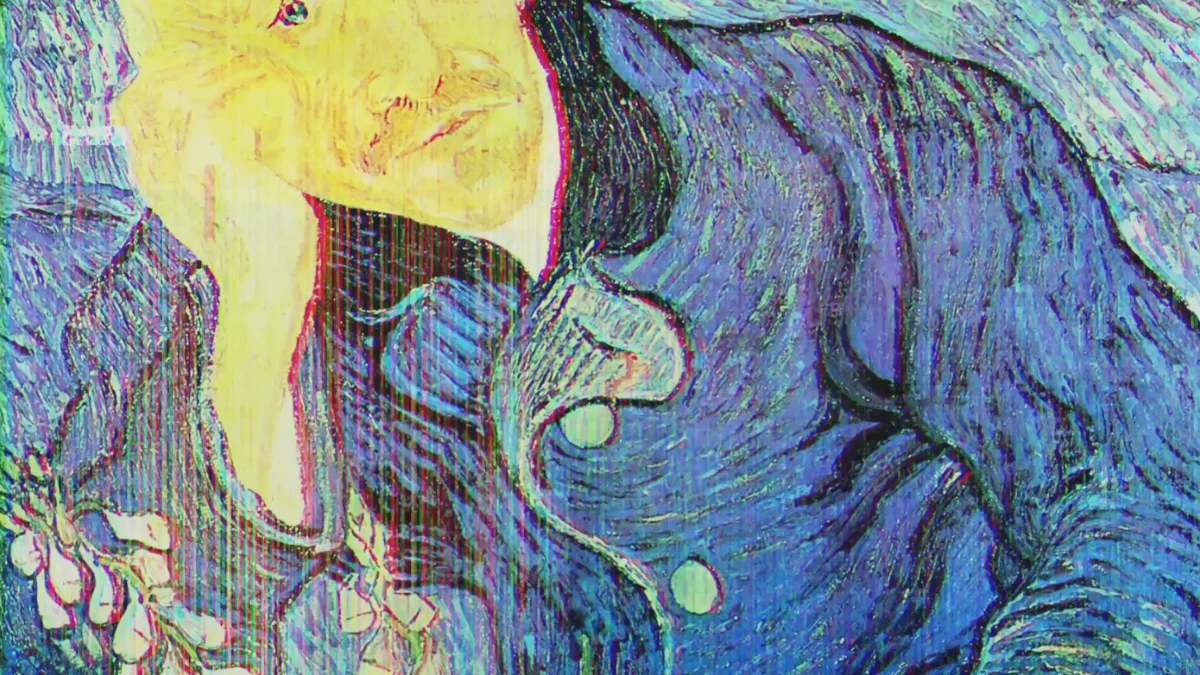
Glitched version of Van Gogh’s Portrait of Dr. Gachet, in which he actually painted the doctor holding a sprig of foxglove. Gachet prescribed digitalis to treat Van Gogh’s “brain fever”. Van Gogh was almost certainly suffering from chronic digitalis toxicity, which people say is why his later paintings had that yellow tint.Text within this block will maintain its original spacing when published
Homo Digitalis

Homo Evolutis

Homo Apathicus

Homo Idiota

Homo Culicidae

Homo Formicidae

Homo Detritus

Homo Obscenus

Homo Assumptus

Homo Morionis

Homo Digitalis.
Justificwtf
I spent exactly nine minutes writing and editing the poem you just read. I know this because the metadata on the original 2017 Word document tells me so. I would love to claim it was birthed in a fugue state of pure, unadulterated genius, but the reality is I likely spent six of those minutes Googling Latin terminology. My dad’s generation were the last ones forced to wear shorts and conjugate verbs in a dead language, and frankly, who has the time now? Mostly just bored taxonomists looking to name an exotic species they’ve spotted in the canopy, just as the bulldozers and the smoke from the palm oil plantation roll in down the road.

The catalyst for this nine-minute sprint was Homo evolutis—a term coined by Juan Enriquez (an academic and biotech investor) and Steve Gullans in a 2009 TED Talk, later expanded into a 2011 book which has literally the most annoying formatting you’ve ever seen in your life. It’s like a Laurence Sterne-obsessed ghostwriter tried to make a gene-splicing clinic’s whitepaper into viral fodder.
Homo Evolutis: TEDsplaining nonsense
I initially wrote the premise off as the profoundly stupid idea that our children might be a different species to us simply because of technology. You cannot breed into a new taxonomic classification just because you have a smartphone. Enriquez was peddling ‘directed evolution’: the breathtaking arrogance that tech-investors and biotech startups can hack the human genome like a piece of software, taking direct control over our biological destiny. I sent the video to a biologist friend of mine, who laughed his arse off. True speciation requires a bit more than an iPad addiction. It requires genetic mutation and reproductive isolation, not a venture capital firm with a CRISPR kit. To think we can engineer our way out of our current taxonomy is to invite a hyper-capitalist, eugenics-lite catastrophe.
Inflict me like a winged insect
You see the exact same pseudo-intellectual scam in Yuval Noah Harari’s Homo Deus. Harari posits that, having supposedly conquered famine and plague (700 million starving souls might disagree), humanity’s next logical step is to upgrade itself into gods via bioengineering and artificial intelligence. It’s no wonder this has become the darling text of Silicon Valley tech-bros and Davos billionaires. Harari shares his vision of ‘Dataism’, where algorithms render the vast majority of humanity economically and politically useless. This is basically a business plan to these people.
Human virus and the myth of nature’s balance
For a long time, I harboured this deep conviction that humans were a unique pestilence. I used to think we shared more in common with a virus than with other mammals, and that the rest of the animal kingdom was striving for noble, harmonious equilibrium.
Watch enough David Attenborough, however, and that romantic illusion is soon turned inside-out by a hungry jaguar. The natural balance of things is actually just a terrifying war of attrition. Take ants. They just march around fucking everything over until they run out of things to fuck over, and then they move on. The only difference is that ants are tiny, they lack nuclear launch codes, and they occasionally get their brains hijacked by a cordyceps fungus.
Interestingly, ants evolved from wasps. They evolved from vespoid wasp ancestors during the Cretaceous period and lost their wings to dominate the terrestrial ecological niche. Yet, the queens still fly when they want to piss off and start a new colony. It’s not unlike our own super-billionaires, the ones with helicopters and their own space programmes, flying above the fray while the rest of us get sat on during the picnic. They have a widespread platform for their moronic ideas, using their vast resources. Much like a $44 billion buyout of our most infectious, information-spreading substrate to turn hapless fux into zombies. A digital cordyceps, otherwise known as X—the Pornhub of bullshit.
Slapping ‘Homo’ in front of a buzzword doesn’t make it evolutionary theory. It is simply the ultimate billionaire hubris: the flying queens deciding to engineer themselves away from the ground-dwelling ants, perfectly content to ignore the ecological firestorm they are leaving behind.
The truth is, humans aren’t uniquely malicious. All life forms, given half a chance, will breed and consume until the oxygen runs out. Look at yeast. Look at rabbits. The only thing that keeps any population in check is the availability of resources. The only reason we sit at the top of the food chain, orchestrating ecological destruction, is that we unlocked the cheat code: extracting incredibly high-yield energy from liquefied prehistoric forests.
The bit that stops your heart
This poem is a precursor to what I consider my best piece, Ant Monkeys—a poem I originally published in The Vein, and which YouTube banned for “hate speech” a decade later. It was a Kafkaesque ruling I’m still paranoid about, as if comparing ourselves to a special breed of formicidae primates was somehow a targeted slur. I haven’t re-published it since then, though the argument was that my hatred was targeted at the entire human species, not one particular marginalised group.
Worthless Poet–Keep the change
The promise of Homo Digitalis was always a lethal illusion of enhancement. Like the foxglove’s cardiac glycosides, our digital substrate merely overclocks the circuitry, forcing the cultural heart to beat with an unnatural, violent rhythm right up until the moment of catastrophic arrhythmia. When Dr. Gachet prescribed digitalis for Van Gogh’s melancholia, the chronic toxicity left the artist with xanthopsia—a neurological glitch that washed his vision in sickly yellow hues and corrupted his optics with swirling halos. We are suffering the exact same toxicity today. Our shared reality is bathed in the pukesome glare of an algorithmic, modernised yellow journalism; a weaponised disinformation that distorts our world while convincing us we’ve never seen so clearly.
Like disinformation, the foxglove and its supply of digitalis is a masterclass in selective hospitality and targeted warfare. The digital substrate (the algorithm, the social media platform) is the foxglove. It is painted with bright, ultraviolet nectar guides (notifications, dopamine hits, metrics) designed exclusively to attract the busy, buzzing workers who cross-pollinate the data. These are your automatons; the clickfux, the red-hatted-haters, the rage-trojans, the hypocritical sycophantic illiterate maggot-brains. They are attracted to this moreish data-stream and they bumble right into it. But to the larger, mammalian ecosystem—the culture at large, the people trying to understand the mindless stupidity of it all—it is packed with a lethal, heart-stopping toxin. It protects its own architecture by poisoning anyone with a real beating mammalian heart that tries to graze on it.
My post-truth poetry is born entirely in that toxic system and its foetid yellow glare. For me, a short poem like this or an angry essay is the necessary counter-measure to the crushing gravity of this digital melancholia. I wrote last time about Suigenesis—the radical, generative decision to rescue the self from the noise and actually start living, even as the system goes into cardiac arrest.
I may have been influenced to publish this old poem and write this desperate essay about winged-ant queen billionaires and heart-stopping toxins because I recently heard that my father is still having heart problems despite his triple-bypass and other invasive surgeries. I remember the foxgloves that grew in the wild abandoned triangle of land behind the mowed lawn of my grandparent’s garden. I found those tall white and purple foxgloves so alluring, but my dad told me not to touch them because they were poisonous. He then went to the pub with my granddad and came home stinking drunk. We all have our vices. Mine is my complicated relationship to my own species, and myself.