What was she thinking?
TL;DR
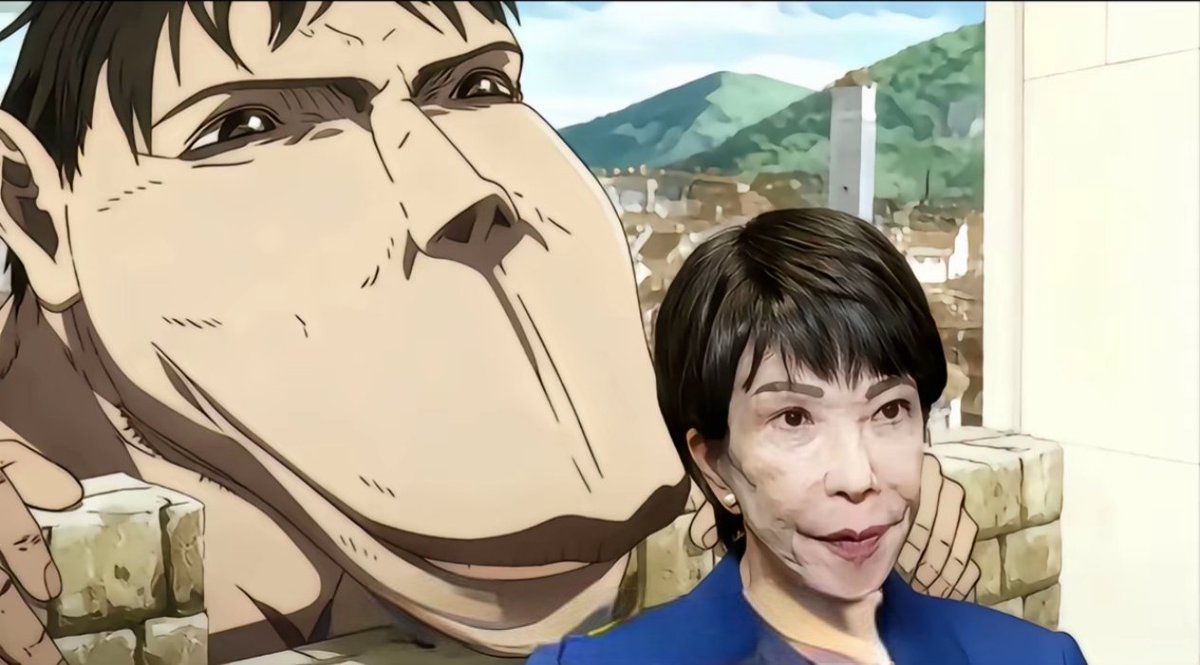
For anyone who doesn’t know, Attack on Titan is a famous Manga with one of the stupidest English translations ever, it should be Attacking Titans!!, Attack on Titan sounds like a sci-fi set on one of Jupiter’s moons. It is also one of the least ambiguous nationalistic allegories ever to break into the mainstream. Of course, it’s nuanced but the basics are this: it has the alt-right connection, and Japan’s PM Takaichi recently quoted it, just weeks after she already massively pissed off China. If you think that’s a coincidence, well… you need to read on.
Here’s a “just the facts” version — I will be getting deeper into it in another post later.
I. Introduction: The Geopolitical Resonance of a Shonen Manga
In the annals of twenty-first-century popular culture, few works have transcended their medium to become genuine geopolitical flashpoints in the manner of Hajime Isayama’s Attack on Titan (Shingeki no Kyojin). What began in 2009 as a visceral, horror-tinged shonen manga about humanity’s survival against cannibalistic giants has metastasized into a sprawling, intricate political allegory that mirrors the most contentious unresolved conflicts of East Asian history. As the series expanded its narrative scope from a simple struggle for survival to a complex war involving racial grievance, historical determinism, and the ethics of preemptive genocide, it ceased to be mere entertainment. Instead, it became a Rorschach test for the anxieties of the post-Cold War order, interpreted variously as a defense of Japanese remilitarization, a critique of the cycle of hatred, a neo-fascist manifesto, and a tragic exploration of the “security dilemma” in international relations.
This report provides an multi-dimensional analysis of the political landscape surrounding Attack on Titan. It interrogates the triangulation of the author, Hajime Isayama, whose alleged revisionist sympathies have sparked diplomatic friction online; the text itself, which employs a “mystery box” narrative to deconstruct and reconstruct the aesthetics of fascism and imperialism; and the state apparatus of Japan, exemplified by Prime Minister Sanae Takaichi’s invocation of the series in December 2025 to court foreign investment and signal a more muscular national posture. By synthesizing English and Japanese discourse, this analysis reveals how a work of fiction has been weaponized by diverse political actors—from Western alt-right forum dwellers to the highest echelons of the Japanese Liberal Democratic Party (LDP)—to articulate visions of power, victimhood, and national identity in a volatile century.
The gravity of this cultural phenomenon cannot be overstated. When a Prime Minister quotes a fictional genocidaire to an audience of global investors in Tokyo, the barrier between “Cool Japan” soft power and “Strong Japan” hard power dissolves. Attack on Titan thus serves as a critical case study in how the unresolved traumas of the 20th century—specifically the legacy of Imperial Japan, the Holocaust, and the colonial subjugation of Asia—continue to haunt the digital and political imaginaries of the present.
II. The Architect of Unease: Hajime Isayama and the Burden of History
To decode the political volatility of Attack on Titan, one must first examine the ideological framework of its creator. Hajime Isayama stands as an enigma in the manga industry; unlike contemporaries who studiously avoid political controversy to maximize mass appeal, Isayama has periodically punctured the “fourth wall” of entertainment to engage with historical narratives that resonate deeply with Japanese conservative revisionism.
2.1 The Dot Pixis and Akiyama Yoshifuru Controversy
The foundational controversy of the series, the “original sin” that has coloured all subsequent political readings, emerged in 2010. Shortly after the manga began its serialization and started gaining traction, Isayama updated his personal blog with a post discussing the character design of Dot Pixis. Pixis, the eccentric, bald, and strategically brilliant commander of the Garrison Regiment, is portrayed within the text as a pragmatic leader who prioritizes the survival of humanity over rigid adherence to law, often serving as a stabilizing, benevolent patriarch figure amidst the chaos of the Titan invasion.
In his blog post, Isayama explicitly stated that Dot Pixis was modelled after the historical figure General Akiyama Yoshifuru. To a domestic Japanese audience educated in the standard post-war curriculum, or specifically those influenced by the romanticized history of the Meiji Restoration (such as Shiba Ryotaro’s popular novel Saka no Ue no Kumo), Akiyama is a hero. He is celebrated as the father of the Japanese cavalry, the strategist who helped defeat the Cossacks during the Russo-Japanese War (1904–1905), and a symbol of Japan’s miraculous modernization against Western imperial powers. Isayama expressed admiration for Akiyama’s frugality, his lack of interest in personal glory, and his supposed scepticism toward unbridled expansionism.
However, the reception of this homage in the broader East Asian sphere was cataclysmic. For audiences in South Korea and China, the distinction between the “heroic” Meiji military and the “fascist” Showa military is a distinction without a difference. General Akiyama served as the commander of the Japanese Garrison Army in Korea and was involved in the First Sino-Japanese War. While he died in 1930 —thereby missing the Manchurian Incident (1931), the Rape of Nanking (1937), and the Pacific War—historians on the continent argue that the military successes of Akiyama’s generation laid the direct logistical and ideological groundwork for the brutal colonization that followed.
The reaction was immediate and vitriolic. Isayama’s blog was flooded with thousands of comments, primarily from Korean internet users, accusing him of glorifying a war criminal. The threats escalated to physical violence, with users threatening to “beat Hajime Isayama to death with a blunt instrument” and burning images of the manga characters. The Electronic Times, a South Korean newspaper, published an editorial in 2013 accusing the series of harbouring a right-wing militaristic message that aligned with the revisionist stance of then-Prime Minister Shinzo Abe.
This incident established a hermeneutic lens through which critics would view the entire series. If the “wise saviour” character (Pixis) is based on an Imperial General, then the “besieged humanity” he protects is easily read as a metaphor for Imperial Japan—a nation that sees itself as surrounded by enemies, fighting a defensive war for survival, even as it engages in militaristic expansion.
2.2 The “Private Account” and the Revisionist Hypothesis
The suspicion of Isayama’s nationalist leanings deepened with the discovery of a Twitter account (allegedly his private alt-account) that engaged in explicit historical revisionism. While Isayama has never officially confirmed ownership of this account, the circumstantial evidence was strong enough to convince large swathes of the fandom and critics.
The account in question engaged in debates regarding the Japanese occupation of Korea, arguing that the colonization was not purely exploitative but “beneficial,” citing investments in infrastructure, population growth, and modernization. This argument—that Japan “civilized” its neighbors—is a standard talking point of the Japanese uyoku (right-wing) and historical revisionist organizations like Nippon Kaigi. The account also reportedly dismissed the “Asian Holocaust” narrative as exaggerated propaganda.
If these views are indeed Isayama’s, they radically recontextualize the narrative arc of Attack on Titan. The story’s central reveal—that the Eldians (the protagonists) are a race despised by the world for “ancient sins” that they have no memory of committing—becomes a potent allegory for the Japanese right-wing grievance narrative. In this reading, modern Japanese people are the “Eldians,” unfairly demonized by China, Korea, and the West (Marley and the World Alliance) for the crimes of the WWII era, crimes which the revisionists argue were either exaggerated or necessary for national survival.
2.3 The “Death of the Author” vs. Authorial Intent
Isayama has been notoriously elusive when directly confronted with these political interpretations. In interviews, he often retreats to the position of an entertainer exploring “universal” themes of power and fear. In a 2013 interview, when asked about the criticism regarding militarism, he stated: “People might believe it if they don’t know when the manga was published… I don’t care much about people’s opinions… Eren and other humans are deliberately emphasized as victims, killing titans for self-defense”.
This defence, however, is precisely what critics find alarming. By emphasizing the “victimhood” of the killer, Isayama replicates the psychological mechanism of what scholar Hyun Joon Kwon calls “victimhood nationalism.” This is the tendency for post-war Japan to narrate its history solely through the lens of the atomic bombings and the firebombing of Tokyo, erasing its role as the aggressor. By creating a fantasy world where the “Japanese” equivalent (Eldians) are objectively the victims of a biological horror, Isayama provides a comforting fantasy for a nation tired of apologizing.
Moreover, Isayama has admitted that his storytelling abilities regarding complex political resolutions are “slight,” and that he felt “least confident” during the political intrigue arcs. This admission suggests that some of the unfortunate political implications may be accidental—the result of a young author borrowing “cool” military aesthetics and “edgy” historical parallels without fully grasping their toxic semiotic weight. Yet, intent matters little to the reception. Whether Isayama is a convinced ideologue or a naive provocateur, the text he produced functions effectively as a reservoir of nationalist imagery.
III. The Architecture of Allegory: Decoding the Walls
Attack on Titan is built on a foundation of allegory that shifts tectonically as the series progresses. The narrative can be divided into two distinct geopolitical phases: the “Island Phase” (Seasons 1-3), which mirrors the isolationist Japan of the Edo and early Meiji periods, and the “World Phase” (Season 4), which mirrors the complex entanglements of the 20th-century World Wars.
3.1 The Walls as the Japanese Archipelago (Galapagos Syndrome)
For the first half of the series, humanity is trapped within three concentric walls (Maria, Rose, Sina). This setting evokes the Sakoku (closed country) policy of Edo-period Japan, but also the modern psychological state known as the “Galapagos Syndrome”—an isolated Japan that evolves uniquely, cut off from global standards.
The most potent political symbol in this phase is the “Vow Renouncing War.” The King of the Walls (Karl Fritz) used the power of the Founding Titan to wipe the memories of his subjects and swore a vow of absolute pacifism. He believed that if his people ever threatened the world again, they deserved to be wiped out. This Vow renders the massive power of the Wall Titans (the nuclear deterrent) unusable, leaving the island vulnerable to attack.
The Article 9 Parallel: The parallel to Article 9 of the Japanese Constitution is unmistakably direct.
- Article 9: “The Japanese people forever renounce war as a sovereign right of the nation… land, sea, and air forces, as well as other war potential, will never be maintained.”
- The Vow: Prevents the Eldian monarchs from using the Titans for defense, accepting eventual extermination as penance for past sins.
In the series, the Vow is depicted not as a noble moral stance, but as a form of suicidal madness imposed by a guilt-ridden leader. The “heroes” of the story (Eren, Erwin Smith, the Survey Corps) are those who reject this pacifism, overthrow the passive government, and seek to remilitarize the nation to ensure survival. This narrative arc aligns perfectly with the political platform of the LDP’s conservative wing, which views the US-imposed constitution as a humiliating shackle that leaves Japan defenseless against a rising China and a nuclear North Korea. By framing the pacifist government as corrupt and delusional, Attack on Titan offers a dramatic argument for constitutional revision.
3.2 The Eldia-Marley Dynamic: The Reversal of the Holocaust
When the basement is opened and the truth of the world is revealed, the allegory becomes infinitely more complex and controversial. The Eldians on the mainland (Marley) are revealed to be living in internment zones, wearing armbands, and subjected to systemic racism.
The Western Reading: Eldians as Jews Western audiences and liberal critics immediately identified the visual coding of the Holocaust. The armbands (reminiscent of the Star of David), the ghettos, and the rhetoric of “devils” led to the interpretation that Eldians represent Jewish people.
- The Ackerman Connection: The prominence of the surname “Ackerman” (Levi, Mikasa) reinforced this. “Ackerman” is a common Ashkenazi Jewish surname. While it also has German etymological roots (“ploughman”) , the combination of the name with the ghetto imagery strongly suggested Jewish coding.
- The Anti-Semitic Trap: If Eldians are Jews, the story enters dangerous territory. The narrative establishes that the Eldian Empire did rule the world for 2,000 years and did commit atrocities using Titans (though the extent is debated). If the allegory holds, it inadvertently validates anti-Semitic conspiracy theories about Jewish global domination and blood libel. This contradiction suggests that the Holocaust imagery is being used for aesthetic impact rather than strict historical allegory, or that the allegory is being subverted.
The Eastern Reading: Eldians as Japanese In the East Asian context, the allegory is read differently. The Eldians represent the Japanese people.
- Historical Inversion: The ancient Eldian Empire represents Imperial Japan. The current nation of Marley (which defeated Eldia) represents the United States or the Allied Powers. The “internment zones” represent the treatment of Japanese-Americans during WWII or the perceived “bullying” of Japan by the international community in the post-war era.
- Manchuria and the Map: The geography of the Attack on Titan world is a reversed map of Africa/Europe, but the geopolitical dynamics often evoke Northeast Asia. The concept of “Honorary Marleyans”—Eldians who fight for their oppressors—mirrors the complex status of colonial subjects in Manchuria or Koreans who served in the Japanese military, as well as the Zainichi Koreans living in Japan today.
3.3 The “Honorary Marleyan” and the Tragedy of Collaboration
The character of Gabi Braun and the “Warrior” unit provide a nuanced look at internalized racism. These “Honorary Marleyans” fight fervently for the nation that oppresses them, hoping to prove they are “good” Eldians. This dynamic is a powerful exploration of the colonial subject’s psyche.
- Historical Parallel: This mirrors the experience of the Nisei (second-generation Japanese Americans) in the 442nd Infantry Regiment, who fought with extraordinary valor for the US to prove their loyalty while their families were in camps.
- Revisionist Twist: However, critics argue that Isayama uses this sympathy to blur the lines between victim and perpetrator. By showing that the “Warriors” (who destroy the Walls) were just brainwashed children trying to save their families, the text humanizes the aggressors of the story (Marley/Warriors). While this works as a humanist anti-war message, in the context of Asian history, it can be read as an attempt to exonerate Imperial Japanese soldiers (“they were just following orders,” “they were victims of the times”) and shift the blame to the abstract “cruelty of the world.”
IV. The Semiotics of Hate: Militarization of the Fandom
The political ambiguity of Attack on Titan has allowed it to be weaponized by diametrically opposed political groups. This phenomenon highlights the danger of “universal” metaphors—when a symbol is sufficiently vague, it can be filled with any ideology.
4.1 The Alt-Right Adoption: “The Red Pill”
In the West, particularly on anonymous imageboards like 4chan and extremist subreddits, Attack on Titan became a canonical text for the Alt-Right.
- The “White Genocide” Narrative: The Eldians are viewed as a proxy for white Europeans—a powerful race with a glorious history that is now demonized by a “globalist” conspiracy (Marley) and forced to feel guilt for the sins of their ancestors. The “Vow Renouncing War” is interpreted as “white guilt” or liberal pacifism that prevents the race from defending itself against demographic replacement.
- Eren as the Übermensch: Eren Yeager’s transformation from a hero to a genocidal nationalist is celebrated rather than condemned. His refusal to accept the world’s judgment and his willingness to destroy all non-Eldians to secure a future for his people aligns with the “14 Words” of white supremacist ideology. Memes depicting Eren in Nazi uniforms or superimposed over antisemitic caricatures are commonplace in these circles.
- “Based” Genocide: The phrase “Eren did nothing wrong” moved from an ironic meme to a genuine political stance within these communities, reflecting a hunger for a “strongman” leader who rejects international law and liberal morality.
4.2 The “Net-Uyoku” and Japanese Nationalism
In Japan, the net-uyoku (internet right-wingers) embraced the series for its perceived critique of the post-war order.
- Anti-Pacifism: The series validates the right-wing belief that pacifism is a luxury that only invites aggression. The fate of the Eldian Restorationists (torture, execution) serves as a warning of what happens when a nation fails to possess the strength to fight.
- Nanking Denialism: The specific plot point where the Marleyan history books are shown to be fabricated propaganda mirrors the revisionist argument that the Nanking Massacre and the “Comfort Women” issue are fabrications by the Chinese Communist Party and South Korea to keep Japan subservient. When Eren realizes the outside world hates them based on “fake history,” it resonates with the revisionist desire to “correct” the historical record.
4.3 The “Tatakae” Imperative: Linguistic Militarization
The central catchphrase of the series, “Tatakae” (Fight/War), serves as a linguistic barometer for the show’s descent into fascism.
- Linguistic Roots: Tatakae (戦え) is the imperative command form of the verb tatakau. It is harsh, direct, and masculine.
- Evolution of Meaning:
- Season 1: It is a cry of survival. “If you don’t fight, you can’t win.” It is the slogan of the oppressed resisting the oppressor.
- Season 4: It becomes a solipsistic mantra. Eren repeats it to himself in a mirror. It decouples from “survival” and attaches to “dominance.” It becomes the justification for the Rumbling.
- Cultural Osmosis: The phrase has permeated Japanese youth culture. While often used innocuously in sports or exams, its association with Eren’s genocidal turn gives it a sinister undertone of “might makes right.”
V. The Takaichi Doctrine: Pop Culture as Statecraft
The theoretical debates surrounding Attack on Titan materialized into hard political reality in December 2025. The invocation of the series by Prime Minister Sanae Takaichi marks a watershed moment in the relationship between anime and the Japanese state.
5.1 The “Davos in the Desert” Speech (December 2025)
The Context: The Future Investment Initiative (FII) Priority Asia conference, dubbed “Davos in the Desert,” was held in Tokyo, marking 70 years of diplomatic relations between Japan and Saudi Arabia. The audience included over 1,000 global executives, Saudi dignitaries, and Japanese business leaders like SoftBank’s Masayoshi Son. Prime Minister Takaichi, facing a contracting economy and pressure to revitalize the “Invest in Japan” brand, needed a message that projected confidence and vitality.
The Quote: Eschewing the humble, self-effacing rhetoric typical of Japanese diplomacy, Takaichi closed her speech with a shock tactic:
“Among works like Captain Tsubasa, One Piece, and Demon Slayer, I would like to conclude today’s speech by borrowing a famous line from Attack on Titan: ‘Just shut your mouths. And invest everything in me!!’“.
The Source Material: The line originates from a pivotal scene where Eren Yeager is on trial. Surrounded by military police and terrified officials debating whether to execute him, Eren snaps. He screams at them to stop their cowardly bickering and put their faith in his power (the Attack Titan) to save them. It is a moment of authoritarian assertion: I have the power, you do not; submit to me, and I will save you.
5.2 The Political Semiotics of the Speech
1. The Shift from “Cool” to “Strong”: For decades, the “Cool Japan” strategy relied on kawaii (cute) exports—Hello Kitty, Pokémon—projecting a harmless, peaceful image. Attack on Titan represents “Strong Japan.” By quoting Eren, Takaichi signaled a shift in national branding. Japan is no longer asking for sympathy or partnership; it is demanding recognition of its latent power. The phrase “Japan is back” (borrowed from Shinzo Abe) was reinforced by the aggression of the anime quote.
2. The Irony of Genocide: Critics immediately pointed out the grotesque irony. The character Takaichi quoted goes on to commit omnicide, wiping out 80% of the human race because he cannot find a diplomatic solution.
- Leftist Critique: Liberal commentators and opposition politicians argued that for a head of state to quote a fictional mass murderer is a diplomatic disaster. It suggests a lack of media literacy or, more disturbingly, a tacit approval of Eren’s “me against the world” mentality.
- The “Dog Whistle”: Some political analysts viewed it as a dog whistle to the nationalist right. Just as Trump uses specific pop-culture memes to signal to his base, Takaichi’s use of Eren—a hero to the net-uyoku—was a signal that she shares their frustration with the “weak” status quo.
3. Economic Desperation: The quote also reveals the desperation of the Japanese economy. The phrase “Invest everything in me!” is a plea. Despite the aggressive tone, it betrays the reality that Japan needs Saudi and Western capital to sustain its aging, shrinking economy. The aggression is a mask for vulnerability—much like Eren’s aggression is a mask for his fear of death.
5.3 Domestic and Global Reaction
The Business Community: Reports indicate the venue erupted in “laughter and applause”. To the international investors, especially those from the Middle East where anime is hugely popular, this was a moment of cultural connection. It showed a Japanese leader who was “in touch” with the country’s most valuable cultural export. It successfully broke the image of the stiff, technocratic LDP politician.
The Online Reaction:
- Twitter/X: The reaction was polarized. Right-wing accounts praised Takaichi as “based” and a “woman of culture.” Left-wing accounts posted images of the “Rumbling” (global genocide) with captions like “Takaichi’s plan for the economy?”.
- International: The story was picked up by global media, framing it as a “bizarre” moment of pop culture diplomacy, further cementing the association between Attack on Titan and the Japanese state.
VI. Data Analysis: The Allegorical Matrix
To visualize the complexity of the allegories, the following table synthesizes the conflicting interpretations of key narrative elements.
| Narrative Element | Interpretative Lens: Western Liberal / Universal Humanist | Interpretative Lens: East Asian Nationalist (China/Korea) | Interpretative Lens: Japanese Right-Wing / Revisionist | Interpretative Lens: Western Alt-Right |
|---|---|---|---|---|
| Eldians (Island) | Humanity fighting for survival against existential threats (Climate Change, War). | Modern Japan playing the victim card; erasing imperial crimes. | Post-war Japan shackled by the US and Article 9; unfairly hated. | White Europeans under siege by globalism and migration. |
| Marley | Fascist regimes; Nazi Germany metaphors (Ghettos, Armbands). | The Allied Powers or China/Korea (hypocritical victors). | The “Globalist” order that imposes guilt narratives on Japan. | The “ZOG” (Zionist Occupied Government) or liberal hegemony. |
| The Titans | The horror of war; nuclear weapons; natural disasters. | The consequences of Japanese militarism returning to haunt them. | The external threat (China/North Korea) that requires rearmament to defeat. | The mindless masses / biological threat to the ethnostate. |
| The Rumbling | The ultimate evil; the failure of diplomacy; Mutually Assured Destruction. | A metaphor for a resurgent, nuclear-armed Japan. | The “Nuclear Option” – a necessary deterrent that Japan is denied. | The “Day of the Rope” – a necessary cleansing to secure the future. |
| Eren Yeager | A tragic villain; a warning against radicalization. | A symbol of unrepentant Japanese aggression. | A tragic hero who does what is necessary to protect the homeland. | A “Chad” nationalist hero; the only one willing to do “what must be done.” |
VII. Conclusion: The Uncontrollable Titan
The trajectory of Attack on Titan from a niche manga to a rhetorical tool for the Japanese Prime Minister demonstrates the fluid and often dangerous power of pop culture in the 21st century. Hajime Isayama, driven by a desire to subvert tropes and express adolescent anxieties about the “cruel world,” constructed a narrative vessel so vast and ambiguous that it could carry the political projections of the entire globe.
This report concludes that while there is no “smoking gun” that proves Isayama intended to write a fascist manifesto, the series operates within a “structure of feeling” that is distinctly aligned with Japanese revisionism. The veneration of Akiyama Yoshifuru, the critique of the pacifist Vow, and the sympathetic framing of the “self-defense” genocide create a narrative space where the aesthetics of militarism are rehabilitated.
The “Takaichi Incident” of December 2025 serves as the final validation of the series’ political utility. By co-opting the language of Eren Yeager, the Japanese state has acknowledged that anime is no longer just a soft power export for tourism—it is a language of hard power assertion. As Japan navigates the treacherous waters of the mid-21st century, debating constitutional revision and rearmament, Attack on Titan stands as a cultural premonition: a warning of what happens when a nation, convinced of its own victimhood and terrified of the world beyond its walls, decides that the only path to peace is to fight. Tatakae.
Key Takeaways for Policymakers and Analysts:
- Cultural Intelligence: Understanding East Asian geopolitical tension requires monitoring pop culture discourse (anime, manga, netizen comments) as closely as official state media.
- The “Victimhood” Pivot: The transition of Japanese nationalism from “apology” to “victimhood/defiance” is clearly charted in the popularity of narratives like Attack on Titan.
- Soft Power Blowback: The “Cool Japan” strategy has a double edge; cultural exports can carry political baggage that alienates neighbors (Korea/China) even as it attracts Western fans.
- Alt-Right Convergence: The alignment between Western digital extremism and Japanese nationalist media is a growing transnational phenomenon that warrants monitoring.
