Part Two of my Spat with Sam Kriss. And why a rich prick can afford to get cancelled.
Dearly beloved, we are gathered here today to witness the binding in holy matrimony of Substack star Sam Kriss with the rotting spectre of his own patrimony. Anyone who objects to this union, let them speak now or forever hold their peace.
I have assigned myself the role of best-man in these proceedings, though I am also the registrar and, maybe, a distant (albeit Northern) cousin of the groom.
Now, we all know that Sam Kriss is spreading across Substack1 like the bacteria from a fart on a petri-dish.
As I chronicled in Part 1 of this saga, my obsession with Substack’s golden child started when a friend introduced me to him because my drunken vitriol, he felt, was reminiscent of Kriss’ angry intellectualism. He was wrong, but sadly that comparison stuck into the slick, fuckable goo of my bitter brain like a grain of sand in an otherwise virginally smooth oyster.
So, I began a campaign of light digital pestilence. For months, Kriss lived rent-free in the expensive penthouse of my mind, leaving the toilet seat in the vertical position, piss stains and brown streaks everywhere else. I wrote a meticulous, long-form parody of his Burning Man essay because I loved it. I stuck up for him over grammar, using my linguistics creds to defend him from grammar mavens who criticised his lack of capitalisation in Substache Notes. I mocked him for being too gloopy. He was constantly bemoaning the lack of a “worthy adversary” on this platform, and the sad truth is, I actually liked Kriss. I didn’t want to write a hit piece about him; I wanted to buy him a drink in a pub one day and make him laugh—a choking, painful laugh that makes the drink come up through his nose and renders the oesophageal mucus into a weapon of synaptic torture.
By mocking his ridiculous lack of knowledge about the word “barbecue”, I managed to get on his radar enough to make The Great Sam Kriss subscribe to Text Parasite. No small feat, he only subscribes to 4 other publications. I was sure fame and that pint were only a few more publications away.
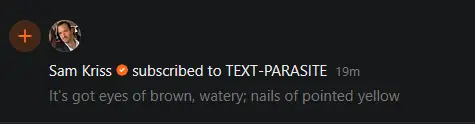
Thinking the grand Frenemy dynamic had officially commenced, I drafted a new Note teasing him again. It was a long, unhinged, self-deprecating ramble about how he was the sword of Damocles hanging over me. I actually called him Samocles. But buried in that note was one specific, fatal sentence about my own Stephen Prime persona:
“bear in mind i am already immensely succesful as a real person… but stephen prime is a nobody and i like it that way. don’t wanna get cancelled, don’t want to have to pander to anybody.”
The reason I left that bit in was really as a warning shot to Sam, who’s been going around rather blithely throwing out accusations that people are using AI and then threatening to kill them for it. I’ve got a more nuanced take on AI than that, and also Stephen Prime is not a real person, so I didn’t want Kriss taking pot shots at me or doxxing me. It was really me saying “don’t throw stones in glass houses” to Sam. I posted it and went to bed. I woke up to absolute oblivion.
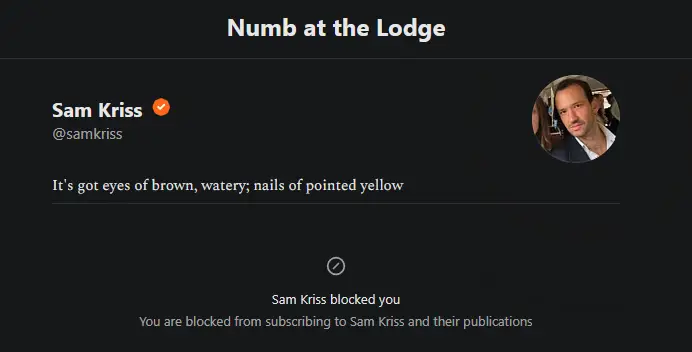
Rather than merely ignored, the note had been nuked. Within forty-eight hours of subscribing to me, Kriss had hit the block button and vaporised my existence from his feed. He asked for an adversary, but when he found one, he hit me with cowardly, silent erasure. It stung worse that he’d actually subscribed first. Why did this seemingly innocuous comment inspire such fear in a substack giant like Kriss? I’ll tell you. It was the mention of the word “cancelled”. You see, Kriss himself got cancelled back in 2017 and he’s hoping everyone’s forgotten. And his hopes, as usual for a plummy silver-spoon champagne socialist, are turning into a lucrative reality for him.
At first, being blocked by my Substack Hero/Envy sponge it felt like a pathetic anti-climax. But the more I thought about it, the more I realised something crucial: Sam Kriss didn’t block me because I was annoying or an unworthy adversary. Rather, I was too much of an adversary for him. He was fucking scared of me. He blocked me because I intimidated him. I was a threat.
He saw a Northern reply guy digging into his history, read the word “cancelled,” and panicked. He thought I was rattling the skeletons in his cupboard. And since he was too much of a coward to face me, I suppose I have no choice but to oblige him and kick the cupboard doors off their well-oiled hinges and dance with the skeletons.
The Ghost of 2017 (The Privilege of Impunity)
What is it about the word “cancelled” that sends a fearless, dissident intellectual running for the block button? Bear in mind, this is a man who proudly states that “You can ambush me outside my home in London, with weapons, if you like.” on the About page of his publications, proclaims himself “your enemy”, and often writes about not being able to find a worthy adversary.
I suppose now we have to talk about 2017. A lot of Kriss’s newer, largely non-British audience on Substack often reacts to his history with a baffled, “Wait, Sam Kriss was MeToo’d?” Yes, he was. Oh, here we go, you might think. The Best Man of the wedding is lacing his speech with inappropriate stories about past indiscretions, for which the groom has paid his penance and we all just want to forget.
No, I’m not doing that. I am not bringing this up to dig in old wounds. I am going to dissect that event quickly, rather than exhuming it. It needs doing though because we have to look at the granular details of that cancellation, as they perfectly expose the bedrock of his entire brand: the privilege of impunity and the true motives of this marriage to his own patrimony.
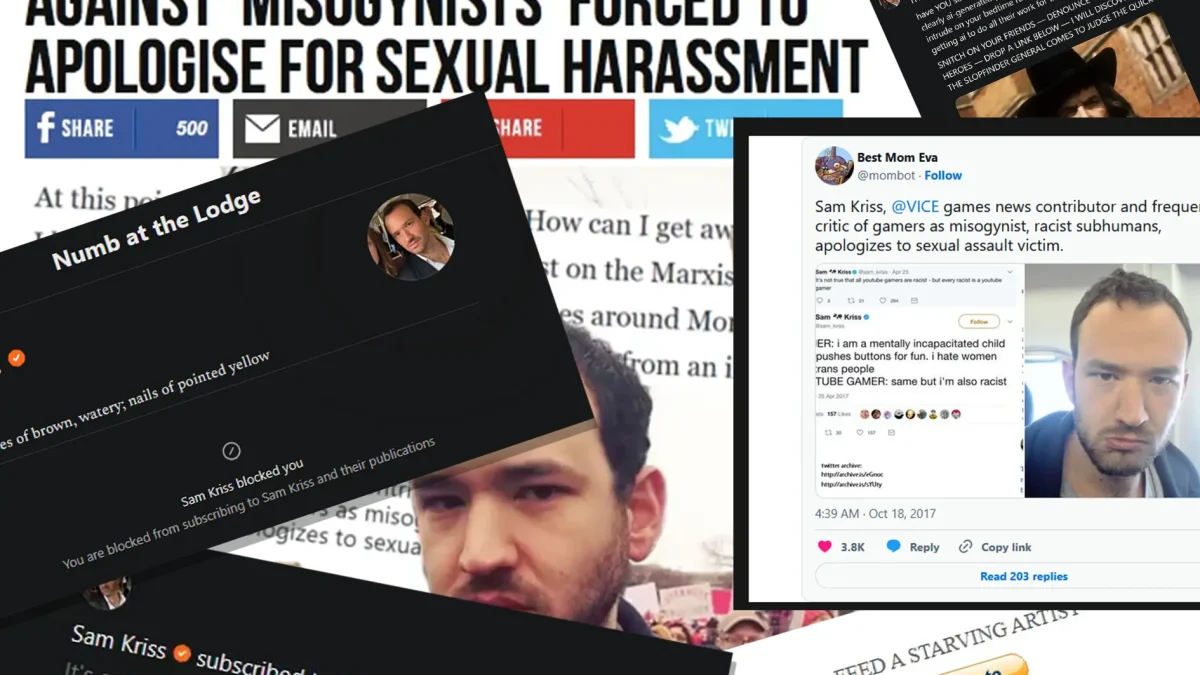
When an anonymous woman came forward on Facebook in 2017 to detail her experiences with Kriss, the harassment itself was not the worst part. The intolerable hypocrisy of it was what made it truly galling. Here was a man circulating in the Marxist far-Left, orbiting Momentum, and writing for Vice and The Guardian. In public, he was a vocal champion of radical politics. In private, according to the woman’s account, he was an unhinged, “hyper heterosexist”.
She said “Sam is, by his own words, from an incredibly wealthy, well-connected background, and therefore compared to me, very powerful.” This is why the woman posted anonymously, as she felt his connections could make things difficult for her. But what made her release her account was stated at the beginning of her account:
“I had hoped I would never have to write this account. But watching a man who repeatedly groped me, twisted my neck to forcibly kiss me, ignored any attempt I made to stop him, and refused to ‘let me’ drink non-alcohol, unashamedly attack feminists online, use misogynist language, singling out women for ridicule time and time again, means I’ve not really been able to forget. With the growing #metoo hashtag there is a context of growing urgency for ‘calling out’ men who sexually harass women. Men who see nothing wrong in sexual aggression, nothing wrong in breaking women’s boundaries, for who the pursuit of sexual contact is undertaken as some sort of mission to make a woman submit to them. This kind of confident, unbridled sexual aggression, founded on an absolute sexism and misogyny, is particularly dangerous. I can no longer bear watching this man behave with total impunity and I feel it’s a duty to warn women about him.”
She recounted the details of a date she’d had with Sam, in which he publicly groped her and forcefully kissed her. When she refused to drink alcohol, preferring orange juice, he bought her wine anyway, flicking his finger against the glass while commanding her: “drink” (flick), “drink” (flick), “I bought you this drink. Drink it” (flick). He grabbed her breasts in the pub. He grabbed them again at a bus stop. He followed her onto a bus to try and pressure her into taking him home, forcing her to physically shove him out the doors.
But the most revealing moment of this entire sordid affair—the moment that strips away the Marxist cosplay and exposes the spoiled patrician beneath—was his idea of seduction.
“Then the various manoeuvres to get me to go home with him began. I want to relay precisely how he first suggested this because it demonstrates a willingness to laud wealth (and thus power).
Sam said, “so do you want to come back to mine to see my massive house?”
“Don’t you mean your parents massive house?”
“Yeah, but when they die I’ll inherit it””
This response was a display of arrogant, aristocratic entitlement, and it’s this which I find the most pukesome and sadly persistent in the whole Sam Kriss phenomenon. This is the exact same bloke who tweeted in August 2017 that in revolutionary China “landlords were made to self-criticise kneeling on broken glass and frankly mao was a big softy who went easy on them”—sneering that denunciations of the Cultural Revolution just boil down to “they made RICH PEOPLE do POOR PEOPLE work!”
Bear in mind, here is a man who still has a little “Donate” button on the bottom of his Idiot Joy Showland WordPress blog, nestled next to which is the phrase ‘FEED A STARVING ARTIST’ because “cheap wine ain’t cheap”.
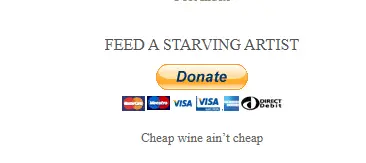
This was actually clever and funny to me when I first read it. But then the joke wears off when you realise this guy is so rich he probably thinks Waitrose is cheap.
Kriss is still at this pretence of poverty, which he monetises. In a 2024 Spectator piece edgily entitled How depressing when people over-identify with their ethnicity, he says “I live in a council estate in London where considerably more than half of my neighbours are Muslims. These people aren’t my friends, but we get along fine: I pick up their parcels; we coordinate complaints to the council about the strange, blue-tinged fluid that sometimes drips from everyone’s ceilings, as if someone in the penthouse had decided to fill their flat with jelly.”
He doesn’t live in a council house. If he does, he’s utterly robbing working-class people of that council house, because by my own calculations with the bare minimum pledge, Sam’s Substack subscribers pay him over 300,000 pounds a year. Note also that Kriss has gone and shifted over to right-wing publications like The Spectator. A cloyingly facile and predictable pattern for a person with very little actual moral fibre but plenty of padding to sit around and wait for a commission, even if it took about six years for people to forget that he ever got cancelled.
When the 2017 scandal broke, the fallout was swift. Labour MP Jess Phillips stated publicly that Kriss’s own confession should be grounds for imprisonment. Kriss had been swift to issue a grovelling apology on Medium, in which he predictably weaponised therapy-speak. He claimed he “wasn’t fully aware of how unwelcome my advances were,” blaming his actions on “not picking up on her signals,” despite admitting he crossed a line into aggression. His apology was removed shortly after it was posted, but it is still available Here thanks to the internet wayback machine. It’s not a great apology really, but it IS a wonderful admission. He said:
“My behaviour was absolutely unacceptable, beneath both me and especially the person involved, and there’s no excuse for it. I’ve apologised privately to her, and I’m apologising, publicly, now.”
His apology affirms that the woman was real, and the events were real, and thus by extension we can assume that the account is factual.
The Facebook post itself garnered only 294 reactions and about 70 comments, but it became slightly bigger news due to Kriss’ being kicked out of the Labour Party and dropped from the various publications that he was a regular contributor to. One chap’s comment reads “Who is Sam Kriss? He sounds like an arrogant arse.” I wish I didn’t know who Sam Kriss is.
One woman commented on the Facebook post “Really powerful account, thank you for sharing. This resonates, met many like this. I hope this arsehole gets his comeuppance, though I guess we all know he probably won’t. At least this serves as a warning.”
Sadly, she was right, but only a few years later. At the time in 2017, the Sam Kriss problem was debated. Several people, including perhaps most prominently Cathy Young, asked if “his defenestration for “sexual assault” unfair punishment? Yes, I absolutely think so. It is a rather stark example of how, in the post-Weinstein era — and even before that, really — complex, ambiguous, gray-area interactions between men and women get reduced to male villainy and female victimhood.”
That’s what Cathy thinks, but she also has an article called “The Rape Culture Myth“ which tells me all I need to know.
Nonetheless, this was the crux of the issue back then. People said a young and upcoming writer had his career ruined by a “bad date”. Any other writer might well have been ruined by this, and that might be a tragedy or well-deserved depending on the facts. But Sam was able to hunker down on Substack and weather the storms of exile thanks to his immense privileges and lack of scruples about cashing in on his own cosplay as a normal bloke. But this still misses the point.
The point is that there are bigger problems with Kriss than this slightly chequered past, and they persist unto this day. He survived this scandal not because of a rigorous moral accounting, but because he brings to this union with himself a handsome dowry: a bottomless patrimony of North London guilt, an unearned sense of tragedy, and three generations of bespoke cushioning to ensure our groom never has to suffer the indignity of an ordinary consequence. And living in a world with so few consequences, seeing him shift over into a right-wing ideological stance after being ousted from the Left, we can still see evidence of his unrepentant arseholery.
Rather than a natural birth, our groom was merely decanted into the chute. He was funnelled with exquisite precision through the great conveyor belt of English polite letters—where radical posture is simply an accessory you purchase alongside the tailored overcoat, and where pretending to hate the bourgeoisie pays sixty quid a year per subscriber from the very people you went to prep school with.
When he was summarily “exiled” from polite legacy media, he didn’t face the working-class reality of bankruptcy or stacking shelves. He simply relocated his megaphone to a direct-debit luxury boutique where his sympathetic peers pay to read his wounded pride. He never had to work a real day in his life, and he never had to issue a genuine apology.
The Mirror and the Trench-Digger
I am not putting Kriss to the sword because I pretend to be a saint. As I’ve written before in Needledick the Bug Fucker in the Mirror, I have certainly been on bad dates where I acted badly because I thought I would get sex. I am no stranger to the ordinary, pathetic flaws of male opportunism.
But there is a vast, systemic difference between the ugly realities of dating and the aristocratic coercion of a man who leverages his parents’ real estate to extract submission. But what truly repulses me about Kriss isn’t just the hypocrisy of his misogyny; it’s the working-class cosplay.
Consider his much-lauded Numb at Burning Man essay—the piece that originally prompted me to write my meticulous, long-form parody, Numbtingly at Burning Man. In his essay, Kriss spends pages exhaustively describing himself digging literal trenches in the desert.
“They put me on manual labour duty. Fine, I thought. I’m used to working with my hands. Typing for a living is a form of working with your hands.”
Actual Burners hated the piece because he essentialised the festival into either a druggy retreat for millionaires in posh tents or a place where the meaning of life should surface.
The top comment on the r/burningman thread where they discuss it reads:
I’ll save you 11,000 words of reading. The gist is “I am very smart, and very deep. Too smart and too deep to enjoy Burning Man with all of the loser tech bros who only think they’re very smart and very deep. Look at all of my literary references and my 1,200 word allegory linking the failed promise of the Soviet Union to my shitty summer vacation.”
Yet, amidst all these wealthy tech-bros, Kriss wants you to focus on his blisters. His trench-digging is a desperate, transparent attempt to make himself look like an impoverished, lowly manual worker who is there only because someone else sponsored him. It is a trope that snakes through all of his writing: the cosplay and the veneer of actually working hard, deployed by a man who was gavaged into the literary elite and never had to graft a day in his life. We’ve seen how he pretends to live in a council house, how he highlights his manual labour and claims to be a starving artist. What kind of starving artist hires someone to “cook on live coals” FFS!?
He wants the aesthetic credibility of a working-class Marxist, but the moment he is challenged, he retreats to the safety of his inheritance and his direct-debit subscriber base. He is the ultimate Champagne Socialist.
“The Littlest Wife” and the Erased Barbecue
He survived the 2017 scandal, but the insidious misogyny and class contempt never actually left—they just morphed into a socially acceptable, performative aesthetic superiority.
Which brings us to his current grift: The Slopfinder General.
Recently, Kriss has decided his ultimate enemy is AI. He wrote a demented piece threatening to come to people’s houses and kill them if they use AI to write. In it, he takes aim at a show called The Littlest Wife. But pay close attention to the framing. He insists his girlfriend made him watch it. He uses his partner as a narrative prop, positioning her as the brainless consumer of trash to elevate his own discerning intellect. It’s an inherently asymmetrical framing—a quiet, insidious misogyny embedded in his everyday aesthetic. She is the little woman, the gateway to the slop, while he is the tortured intellectual suffering the indignities of her viewing habits. He hates the show because he claims the writers used AI to write it and he can tell.
He applies this exact same performative superiority to the working classes. It was in this same piece that he railed against caterers for allegedly using AI to describe their services. He was furious that they were generating marketing babble for the copy on their websites.
Later, he acknowledges the counter-argument with a bit of classic hyperbole.
“The writers and showrunners of The Littlest Wife are called Jennifer Ames and Steve Turner. They are apparently quite a powerful pair; they previously worked together on Boardwalk Empire. I don’t know exactly how much they got paid for ‘nursing the burn of every sip,’ but I’m sure it was plenty. Enough to feed an entire village of semi-literate Cambodian peasants for a hundred years. I’m just not sure why they should get that money, when their job could just as well be done by any one of those semi-literate Cambodian villagers. This is the democratising power of AI I’ve heard so much about, isn’t it? If you’re a pair of lazy, talentless hacks, gobbling up opportunities more interesting people would kill for and then not even bothering to write the show yourself, sooner or later, the people who sign your cheques will cut out the middleman, and you will deserve it.”
The phrasing about the Cambodian peasants is clever (especially in the full context) until you realise it’s a red herring. The point is that his claim to be able to tell if someone used AI is inherently ignorant. First of all, humans are actually being influenced by LLMs and this is a phenomenon reported by several independent researchers in Nature amongst others. It is possible for humans to write sentences that sound like AI, just as AI can write sentences that sound human. But, this also misses the point. Kriss riles against the way AI works, demonstrating a severe lack of understanding. He says:
“the people who get exposed are a tiny minority of those actually pushing the big button on everyone’s desk marked ‘DO MY ENTIRE JOB FOR ME.’”
If you think an LLM can write a publishable piece with one press of a button, you clearly haven’t worked with them much. But perhaps these people who he literally names and shames as 100% proven guilt cases of AI over-reliance (taking umbrage, ironically with how much they must have been paid for their work of doing very little) do deserve to be ridiculed for their poor stylistic choices. These are full-time journalists he’s talking about though… people with deadlines and bills to pay. People who can’t play the game of being a writer whilst never experiencing the crushing reality of having to work for a living or not being cushioned by privilege enough to spend 11,000 words talking about a slightly muddy free holiday they took to the Nevada desert.
Kriss does not understand that boilerplate marketing language on a caterer’s website does not deserve the same level of critical appraisal as his beloved Joyce, and it’s nothing to get all het up about. It’s just a website, Sam. Not everyone can afford to reach the plummy heights of verbiage as you, Sam. Fuck off, Sam.
Back before he blocked me, when I was able to point this out in his comments section, I mocked the fact that he was too upper-class to know the word for heating the flesh of a ground-up cow on a griddle stocked with burnt wood from B&Q. At first he just ignored it, it was only when I pointed out his snobbery by thanking Mapu (get well soon my lovely! Rooting for you!) for deigning to reply from the lofty heights of having an orange tick next to your name on Substcack that he decided to engage with me. But then in blocking me he scorched the comment from the record. I admit I’m a little sore that he blocked me like that, but to be honest even before I had already started drafting a piece entitled “has Sam Kriss finally gone insane” in which I was going to unpack his over-zealous and frankly rabid diatribes against AI writing.
This lazy technological determinism is exhausting. Kriss hates AI, but not because he possesses some sacred artistic purity. History is full of revered content mills. Alexandre Dumas ran a literal literary sweatshop, employing talented nobodies and churning out serialised slop to the point where he was famously sued for it by his own chief collaborator, Auguste Maquet. Artists like Damien Fucking Hirst don’t even touch the art they sell; they use the vast, institutional machinery of their power to hire interns, thus fully outstripping any true indie talent who are actually grafting in the trenches by paying then peanuts to saw calves in half and stick diamonds onto a skull, for fuck’s sake.
Sam Kriss was born into that exact machinery. He no doubt actually feels threatened by AI because it democratises the slop, hence his hyperbolic rant about Cambodian peasants (people who he has himself exploited in his popular travel writing, where he plays at being a cash-poor backpacker). Now anybody can churn out marketing babble for their website, and they don’t need Kriss’ inherited and unearned wealth to afford to pay a copywriter. AI threatens the monopoly of the bespoke, artisanal, ruling-class slop that he peddles to his echo chamber. AI means that the peasants can generate their own verbiage without having to spend fifty grand on a humanities degree to learn how to properly deploy a semicolon.
The Dostoyevsky Annulment
This deep-seated terror of mass-produced, accessible content is what recently drove Kriss to completely abandon his senses and go insane. He has literally branded himself “THE SLOPFINDER GENERAL,” posting images of Vincent Price’s 17th-century witch hunter while demanding his followers “SNITCH ON YOUR FRIENDS — DENOUNCE YOUR ENEMIES — BETRAY YOUR HEROES” so that he can “JUDGE THE QUICK AND THE DEAD”.
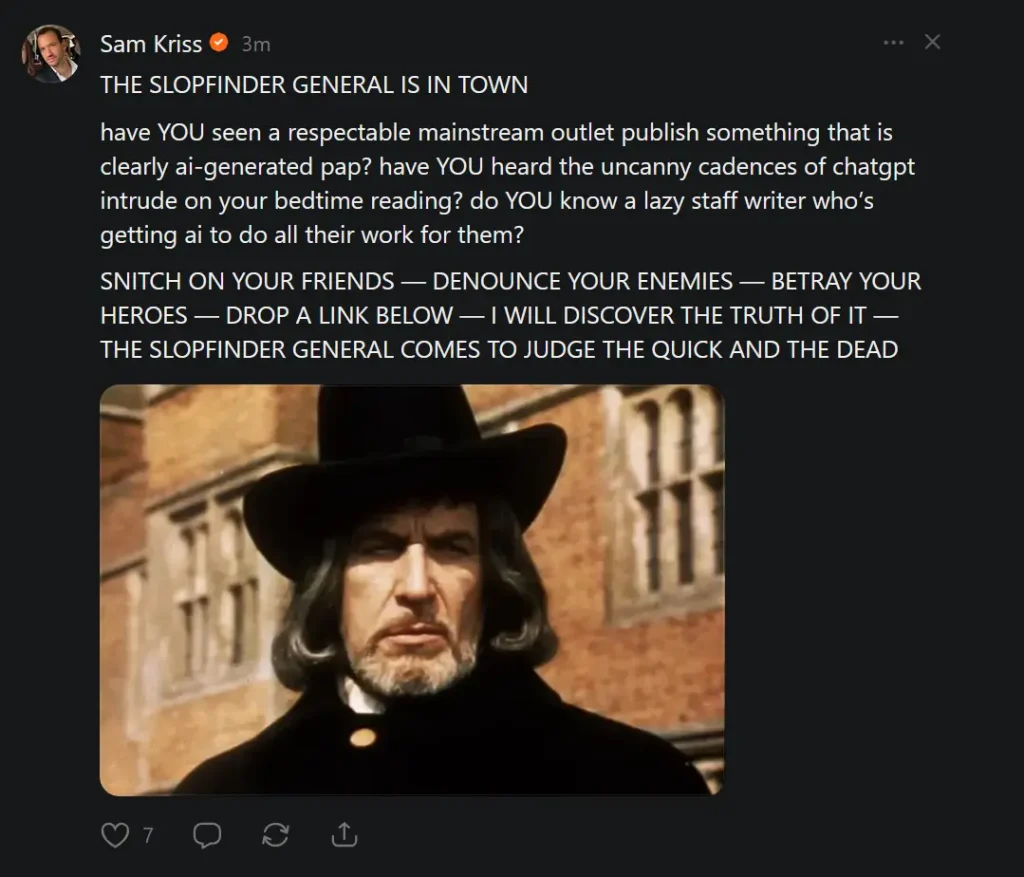
But here is the breathtaking paradox: to execute these grand witch hunts against “lazy staff writers”, what does our fearless Slopfinder use? An AI program.
While threatening to kill people who use AI, Sam Kriss simultaneously wrote an essay in Notes titled “HOW I LEARNED TO STOP WORRYING AND LOVE PANGRAM,” publicly defending the use of a flawed AI detection software. He used this algorithm to publicly accuse Will Self of publishing a political obituary that was “absolutely 100% lifeless regurgitated ai dreck from start to finish”. He hates artificial intelligence, yet he trusts a machine algorithm to execute his vendettas—defending Pangram with the sort of zealous loyalty that sadly Allen Ginsberg reserved for sticking up for NAMBLA, just so he can maintain his superiority complex over other writers.
You would think a man who knows first-hand what a career-ending online pile-on feels like would be a little more cautious about throwing stones in glass houses. Because in 2026, an AI accusation isn’t some cheeky literary spat—it is enough to end a writer’s career. Earlier this year, Hachette pulled Mia Ballard’s horror novel Shy Girl off the shelves over online AI speculation, and Trinidadian author Jamir Nazir had to survive a brutal public backlash and formal review just to keep his Commonwealth Short Story Prize. Literally days ago, the Caine Prize for African Writing had to formally clear Zimbabwean author Simbarashe Kundizeza after The Atlantic ran a hit piece accusing him of using AI based on—you guessed it—Pangram.
Even Kriss’s own loyal subscribers are getting noticeably uncomfortable watching him name and shame working writers, yet in his latest Note he is still furiously sticking up for Pangram. When the mob came for him in 2017, it was a tragedy of the puritanical horde; when he sics a black-box algorithm on everyone else, it’s a noble crusade. It is this exact same smug compulsion to police the gates of “real” literature that also drove him to try and cancel Fyodor Dostoyevsky.
Back when I first joined Substack, Dostoyevsky was trending massively. Everyone was name-dropping him to sound intellectual, building a whole ecosystem of ponderous, literary posturing. It peaked when Liza Libes posted an earnest (and frankly, awful) note about reading Dostoyevsky at 15, asking why “engaging deeply with ideas” is considered pretentious. Another user, Philip Traylen, chimed in to say that “disliking Dostoevsky is one of the least interesting forms of self-denial”. Let’s note here that anyone who doesn’t speak Russian is unable to authoritatively comment on Dostoevsky’s actual writing style, since translation is itself a highly creative act that renders the original work through an infinity filter.
Kriss, constitutionally incapable of letting a trend go by without proving he is above it, took the bait. He launched into an unhinged, pedantic rant, tearing down Dostoyevsky as “basically monstrous, heavy and hysterical,” populated by “shrieking old women who turn white or purple every other paragraph”. He smugly contrasted this with the “deeply musical qualities of joyce”. He dismissed anyone finding unadulterated beauty in Dostoyevsky as performing a “rote fetishistic invocation of the jordan peterson bookshelf,” concluding his literary critique with a refined: “you are an illiterate. fuck off”.
Then, a commenter named Andrew Wilson lobbed a perfect setup into the thread, suggesting that Dostoyevsky would have been on Substack. Kriss replied with this punchline: “yes dostoevsky would have absolutely been on substack and that’s a very good encapsulation of exactly what’s wrong with him”.
I’m not going to lie. That is a genuinely funny line. When I first read that exchange, it made me laugh out loud. I have never denied that Kriss is a very good writer. But this is exactly where the trap lies. This pre-emptive, self-deprecating irony is his ultimate champagne socialist armour.
He knows exactly what he is doing. He knows he is on Substack. By loudly proclaiming that Substack is a trash medium for hacks, he signals to his audience that he is intellectually superior to the very platform paying his bills. It’s the rhetorical equivalent of his Burning Man trenches. He is slumming it on Substack, but he wants everyone to know he doesn’t truly belong with the peasants. Those of us who remember 2017 know why he’s really here. Making a clever joke about being a serialised hack is his way of absolving himself of the reality that he actually is one.
He hates Dostoyevsky for the exact same reason he has gone rabid over AI. Dostoyevsky’s prose was a swamp of serialised instalments written by a hack desperate to pay off his gambling debts. Kriss, meanwhile, is an intensely unpleasant, entitled prick cosplaying as a struggling artist, begging you to “Feed a Starving Artist” while waiting for his massive inheritance.
By mocking Dostoyevsky as a serialised hack on Substack, he unwittingly annulled his own legacy. He is the serialised hack of the modern age, writing in instalments—just without the gambling debts, the Siberian gulag, or the actual, world-altering genius.
Which brings us back to the altar, and it’s time to wrap up my best man’s speech (no idea why I decided to frame this essay as a wedding vow but it’s too late to change it now).
Do you, Sam, take this manufactured rebellion to be your lawful wedded brand? To perform an exquisite, performative despair in sickness and in health, so long as the Substack payouts clear?
I now pronounce you man and patrimony. You may continue to autosodomise yourself for us all to see, especially those behind your paywall.
As for the rest of you, let Kriss keep his direct-debit luxury boutique. To my beloved Mapu—who originally sprung the trap for me from the Orange Tick wings—and to all the true, gritty indie voices grafting in the trenches without a North London safety net: it’s time to reject these legacy-media transplants. Leave the champagne socialists at the altar and dance with me in the true squalor, where we know words like ‘barbecue’ and can cook our own meat.
1 which is, undoubtedly, a sinking ship, let’s face it. It’s gone all video-whirly and poppoppow-SNS. Nazis and Manosphere mugs—including Andrew Tate hitting #1 bestseller back in April—are making bank on this platform too, so if you’re here you’re complicit. But hey, the whole world is going a bit fascist so what else is new, eh?
