
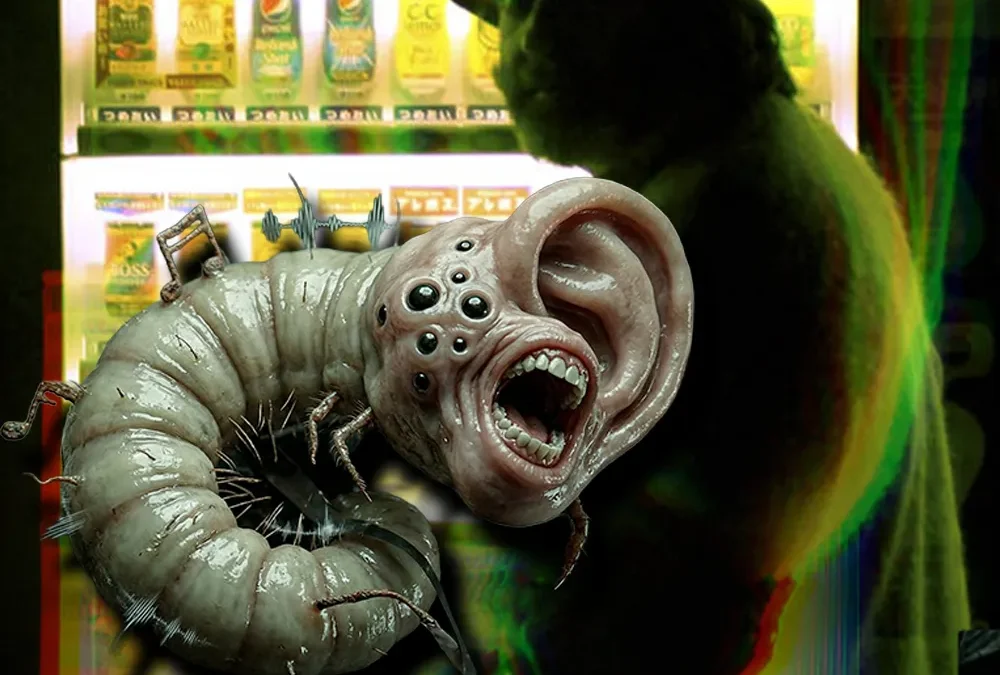
I’m starting a new category on my bloge about whatever EARWORMS I got. Don’t worry, it’s not God Speed You! Black Emperor (that would be an inhumane motherfucker of an earworm). This time it’s fellow Japan resident and true-to-himself legend, Jim O’Rourke.
For those who think I’m being disgusting once again or don’t know the term, an ear worm is the sort of odd way we have of describing a song that you get stuck in your head… like the Triple Dent Gum ad from Inside Out—designed by Pixar specifically to be a cognitive parasite. It’s loud, bright, and corporate, and totally lodged itself in my head even as it taught me the word.
While it feels very American because of its prevalence in US pop culture (and movies like Inside Out), Earworm actually has a surprisingly continental origin.
The Etymology: Ohrwurm
The term is a calque (a word-for-word translation) of the German word Ohrwurm.
- In German, it has been used for over a century to describe a “musical itch” or a tune that won’t leave you alone.
- It only really started “infecting” the English language in the late 1970s and 80s, popularized by authors like Stephen King and journalists writing about music psychology.
Anyway, enough about words, onto the music! This being the first one of my Earworms series, I wanted it to be a good one… and it’s a surprise for me as I always feel I don’t listen to enough Jim O’Rourke.
What I love about this song is the way that it never ends… it just keeps going and then cleverly fades into a strings version and then somehow comes back drums blazing again for the finale of the finale. It’s mental. It’s genius.
Here are the lyrics and the song:
I know you think the sun is shining
And I hate to let you down, so
I’ll just say “Please watch your head”
Cause you don’t wanna admit
You’re not as tall as before

If you think your glass is half full
Might be best for you to take off now
Cause the half that remains
Is little more than a stain
That sticks to you like a shroud

Now that should start you a-wonderin'
How it looks to somebody dense
It's never occurred to you before
And a little late to bring it up

If you stop to think about it
Might be time to cash in your chips, cause
You can tell from your face
That you're a charity case
And your debt is pilin' up
You might also like
Hotel Blue
Jim O'Rourke
That Weekend
Jim O'Rourke
Hummingbird
Wilco

It's easy when you were floating
Above everybody for years
You can't breathe in that air
If there's nobody there
To gaze at you from below

We'll drop in and drop out

People drop in and drop out of your sight
And that’s what you call a radical life
Now I’magonna analyse the lyrics so that it constitutes as fair use.
That’s the only reason I’m doing this, I don’t enjoy doing this type of thing you know. You have to read it otherwise Jim might be sad…
The song’s all about someone who was an arsehole but sorta got their comeuppance I bet. I reckon Jim has met loads of people like that, being in the music biz and keeping it real himself all his life, from humble beginnings to jamming with Sonic Youth and probably having a bit of a crush on Kim Gordon and then being in the middle of the whole Thurston breakup thing and then going to Japan to take that goofy photo of him in front of a Japanese vending machine that has been his profile picture for like a decade.
That line “Cause the half that remains / Is little more than a stain / That sticks to you like a shroud” is classic Jim O’Rourke cynicism. While the title Simple Songs suggests something light, “Half Life Crisis” is a masterclass in Art Rock subverting the singer-songwriter trope. He takes the “glass half full” optimism and turns it into something decaying and inescapable (Just as I have done here). It’s that contrast between the jaunty, polished 70s-pop production and the absolutely brutal lyrics that makes this a permanent earworm.
I also love the lines “You can tell from your face / That you’re a charity case / And your debt is pilin’ up”. Such a gentle yet savage roast.
Did you know “Half Life Crisis” wasn’t even recorded in a proper Tokyo studio? Because Japanese studios are eye-wateringly expensive, Jim O’Rourke and his band (including Eiko Ishibashi and Tatsuhisa Yamamoto) decampedto a two-storey wooden cabin in the mountains of Yamanashi. It was built by a retired dentist who wanted a home studio but never finished it. They had to record there just so the cops wouldn’t be called because of the noise.
Nihonshuuuz: Jim O’Rourke in Japan
Jim O’Rourke moved to Tokyo permanently around 2005/2006 after touring for Sonic Youth’s Sonic Nurse finished. He famously sold all his instruments before the move, spent two years just learning Japanese, and now says he speaks more Japanese than English. He’s become a cornerstone of the Tokyo experimental scene, collaborating with icons like Keiji Haino and Merzbow.
Legendary Japanese director Kōji Wakamatsu asked Jim to score his film United Red Army. The catch? Wakamatsu told him he’d only work with him if Jim learned Japanese. Jim was so determined that he spent about 90% of his time over two years doing nothing but studying and watching Japanese films to get his visa and the gig.
When he moved to Tokyo, he famously sold off almost all his instruments and equipment. He intentionally stripped away his “musician” identity so he could focus entirely on integrating and learning the language.
He reportedly treated language learning like he treats a complex mix in the studio—total, microscopic immersion. He’s mentioned in interviews that he spent years barely speaking English, to the point where he now says he feels more comfortable speaking the “local brogue.”
In interviews, Jim has mentioned that moving to Japan was the only way he could finally get his brain to “shut the hell up.” He’s also a massive fan of Nihonshu (sake), claiming it’s one of the best things that ever happened to him because it’s the only thing that helps him stop thinking about work for the day. Living the Salaryman dream, but for avant-garde legends.
Jim O’Rourke is a regular fixture at Star Pine’s Cafe in Kichijoji. He often plays there with his “Kafka Ibiki” trio (with Eiko Ishibashi and Tatsuhisa Yamamoto). He actually just did a stint there in January 2026 for Akira Sakata’s 70th-birthday series. Kichijoji is basically his home turf for performances.
He frequently pops up at WWW or WWW X in Shibuya, especially for events like MUTEK.JP. He performed there in late 2025. These shows are usually focused on electroacoustic improvisation—very different from the Simple Songs vibe, but you get to see him in his element behind a modular synth or a laptop.
For the more “jazz/avant-garde” Jim O’Rourke, keep an eye on the schedule at Shinjuku Pit Inn. He has a long history of performing there with Otomo Yoshihide. It’s a legendary basement spot where the barrier between the “stage” and the audience is basically non-existent.
He is currently gearing up for a European tour (including the Rewire Festival) this month and into May 2026. Once he’s back in Japan, he usually settles back into a rhythm of one-off collaborative shows in Tokyo.
Yeah all that.
