A short examination of the Substack moderation controversy in relation to toxic masculinity and the manosphere.
“Don’t be a Dick” — Unless It’s on Substack
When I first started spending serious time on Substack, the platform’s recommendation engine immediately began enthusiastically chucking a very specific species of writer my way. You know the exact type. Hapless fux who post three cryptic sentences—something vaguely Spenglerian about decadence, the fall of empire, maybe a stray, badly conjugated Latin phrase—and somehow they’ve already accumulated two thousand followers. It felt eerily familiar, like stumbling back into the algorithmic swamp of Weird Twitter circa 2016, only this time everyone is trying to sell you a subscription to their bespoke flavour of cultural resentment.
So, naturally, being a curious fuckwit, I did what everyone does. I followed them.
At first, it seemed genuinely intriguing. A loose network of irony-laced micro-essayists operating in a liminal space: half philosophy, half shitposting. The aesthetic was undeniably appealing—minimalist newsletters, obscure historical references, the distinct vibe of a dim café somewhere between Vienna and Discord. I assumed I’d found a pocket of interesting thinkers experimenting with long-form writing.
But after a few weeks of actually reading them, the intellectual mirage evaporated. The cryptic aphorisms expanded into full essays, and once inflated, the ideas inside them turned out to be astoundingly thin. It became glaringly obvious that a vast swathe of these writers were just peddling a toxic mixture of incel-adjacent grievance politics, faux-academic grandstanding, and that peculiar online pathology where someone mistakes a bloated vocabulary for actual intelligence. They were just deploying ornate clouds of language, these pricks… not anything of substance. The rhetorical equivalent of someone belching thesaurus entries instead of making a point. I’ve sat next to these kinds of twit at dinner parties. It’s why I never go out anymore.
At first, I treated the whole thing anthropologically. I’d open these newsletters with the same clinical curiosity you might bring to a strange, slightly unhinged academic conference: let’s see what these people are actually talking about. But over time, a bleak pattern emerged. Many of these writers weren’t particularly interested in writing. They were interested in posture. Elaborate pseudo-intellectual frameworks built entirely on “vibes” (whatever that fucking means). Occasionally there was a flash of insight, but mostly it was the rhetorical equivalent of someone pacing around a room trying to look profound while nursing a massive grievance. And the deeper you read, the more the underlying emotional tone surfaced: resentment, loneliness, and a kind of brittle masculinity constantly narrating its own tragic decline.
Eventually, I realised something mildly unsettling: the platform had quietly and deliberately funnelled me into a very particular ideological neighbourhood. And it wasn’t an accident. This is related to the massive Substack moderation controversy which has plagued the platform recently, and is a design inevitability.
The digital public sphere has undergone a profound structural transformation over the past decade. The dominant paradigm of the early twenty-first century was characterised by open, algorithmically curated, and advertising-supported social networks. This is increasingly giving way to a decentralised ecosystem of closed, subscription-based, direct-to-consumer publication platforms. This transition was heralded as the maturation of the “creator economy,” explicitly designed to liberate independent writers from the capricious algorithms and stringent brand-safety requirements of legacy social media platforms such as YouTube, Twitter, and Meta (obviously before Twitter became X which is now a bagpipe of fake news, open hate, and worse).
However, this architectural shift has produced profound and deeply concerning unintended consequences. By stripping away the moderation constraints dictated by corporate advertisers, subscription platforms have inadvertently cultivated highly fertile ground for ideological extremism, radicalisation, and the unchecked proliferation of male supremacist content. Nowhere is this phenomenon more acutely visible than in the rapid expansion of the “manosphere” on Substack; it’s become a jacuzzi of farting alphas and gigachad wankers.
This decentralised online coalition of misogynists, involuntary celibates (incels), pickup artists (PUAs), and red pill ideologues has effectively weaponised the newsletter format. They use it to bypass mainstream censorship, build insulated ideological communities, and generate substantial recurring revenue. The manosphere effectively targets the legitimate anxieties of young men navigating a rapidly changing socioeconomic landscape. The erosion of traditional industrial employment, evolving gender roles (terrifying to a virgin male overdosing on testosterone), and an acute “male loneliness epidemic” have left a demographic cohort feeling alienated and devoid of societal purpose. These people are not bad people yet, they are just confused and rather empty. Extremist influencers exploit this vacuum, offering a carefully constructed Trojan horse for reactionary gender politics. The underlying message asserts that the chaos and misery of modern life are directly caused by feminism, and that order can only be restored through the reassertion of dominant, traditional masculinity.
Substack is uniquely engineered to capitalise on this absolute clusterfuck of demographic anxiety. The Substack moderation controversy is no accident. The platform operates on a revenue-sharing basis, taking a flat ten percent commission on all paid subscriptions. Consequently, the platform directly profits from the dissemination of hate speech and misogyny. Legacy social networks generate revenue primarily through targeted advertising, which demands “brand safety” and forces platforms to enforce strict content moderation policies. In stark contrast, Substack’s primary customer is the writer, and the writer’s customer is the individual subscriber. Because there are no corporate advertisers to appease, Substack faces no immediate financial penalty for hosting extreme or highly controversial content.
In fact, the economics of the creator platform actively reward polarisation. Highly polarising, grievance-driven content generates intense parasocial loyalty, deep emotional investment, and exceptionally high conversion rates for paid subscriptions. Every time a user subscribes to a deeply chauvinistic newsletter, Substack takes its ten percent cut, effectively positioning the corporation as a direct beneficiary of digital hate. The orange in that logo seems a bit more than a coincidence, now, doesn’t it?
When high-profile creators inevitably face demonetisation or deplatforming from mainstream networks due to violations of hate speech policies, they engage in “platform-hopping”. They migrate their highly loyal, algorithmically radicalised audiences to alternative, lightly moderated subscription platforms like Substack, transforming their ideological influence into direct, recurring financial support.
And there I was, caught in the splash zone of this digital migration, wondering why my inbox was suddenly full of amateur Nietzscheans who treat the phrase “civilisational collapse” like a punctuation mark. It took me a while to notice… I couldn’t hear the dog whistles but I could smell the farts.
The Algorithmic Mirror and the Banality of the Male Gaze
Recommendation systems are mirrors of a sort. They reflect patterns in your behaviour back at you, often with the brutal, unflattering clarity of a changing room strip light. If Substack’s algorithm decided I belonged in that particular corner of the discourse ecosystem, it meant something in my reading habits—my follows, my clicks, my interests—made the machine calculate that we were ideologically adjacent.
Which raises a deeply uncomfortable question: what exactly about my output made the machine decide that this was my tribe?
Algorithms, bless their cold, mechanical hearts, cluster people through crude similarity metrics: shared subscribers, shared keywords, shared networks of followers. The platform actively aids in the discoverability of content through its internal recommendation engine, which cross-promotes newsletters to similar audiences. It’s entirely possible the answer is banal; perhaps I merely brushed against the same intellectual ecosystem without realising it.
But there is a more insidious, and frankly more embarrassing, explanation. Perhaps the algorithm sensed something that humans often miss about themselves: that a morbid curiosity about the strange, dark corners of the internet can look, from the outside, an awful lot like ideological alignment.
Consider my recent output. I wrote a somewhat gritty piece about a bloke self-hosting his own vast, bespoke porn collection—a nod to the home-lab tech crowd, perhaps, but undeniably ripe for algorithmic misinterpretation. I published a visceral, horrifying account of a drug addict whose life disintegrated utterly when his motherless toddler pulled his eyeball out of its socket while he watched, helpless. I even penned a scathing critique of the new Japanese prime minister—the nation’s first female PM, who confidently declared her gender irrelevant and then promptly proved it by doing absolutely fuck-all to address the country’s yawning gender gap. I also wrote a piece about a guy who smokes someone’s mother’s ashes, and I’m really fucking proud of it. Of course, the refrain of even the most misogynistic of misogynists is “I love my mum, therefore how can you say I hate women?” Whilst it’s true I love my mum, this piece wasn’t meant to belittle the role of mothers but a close-to-the-bone critique of Grief Tourism, which ideologically aligns me with internet trolls I’m afraid, though I am not an internet troll but a self-described Doomscroll Flâneur.
To a nuanced human reader, these are explorations of human frailty, technology, and political hypocrisy. To a blunt-force recommendation engine designed to maximise engagement farming, these topics are pure, unadulterated “edge.” The machine saw “porn,” “violence,” and criticising a female politician, and immediately placed me squarely on the event horizon of various catchment algorithms. It looked at my work and thought: Ah, excellent, a new recruit for the irony bros.
Meanwhile, my actual ideological signals were entirely ignored. I accurately quoted Margaret Atwood on a popular feminist post—the classic observation that men are afraid women will laugh at them, but women are afraid men will kill them—and I received exactly zero new subscribers for my trouble. Nuance and genuine allyship do not drive the outrage machine. They do not trigger the algorithmic amplification that seamlessly converts public anger into private revenue. Substack Notes, which operates much like X but is deeply embedded in the subscription flow , is aggressively utilised by manosphere writers to farm engagement from this exact kind of outrage. They post highly inflammatory takes specifically designed to trigger liberal or feminist users, driving massive organic traffic back to their paywalled newsletters.
But perhaps the most chilling aspect of this whole debacle is how deeply normalised this insidious misogyny has become. It doesn’t always wear a high-vis jacket and scream from the digital rooftops about alpha males and hypergamy. Often, it wears the comfortable, tweedy cardigan of the intellectual ally.
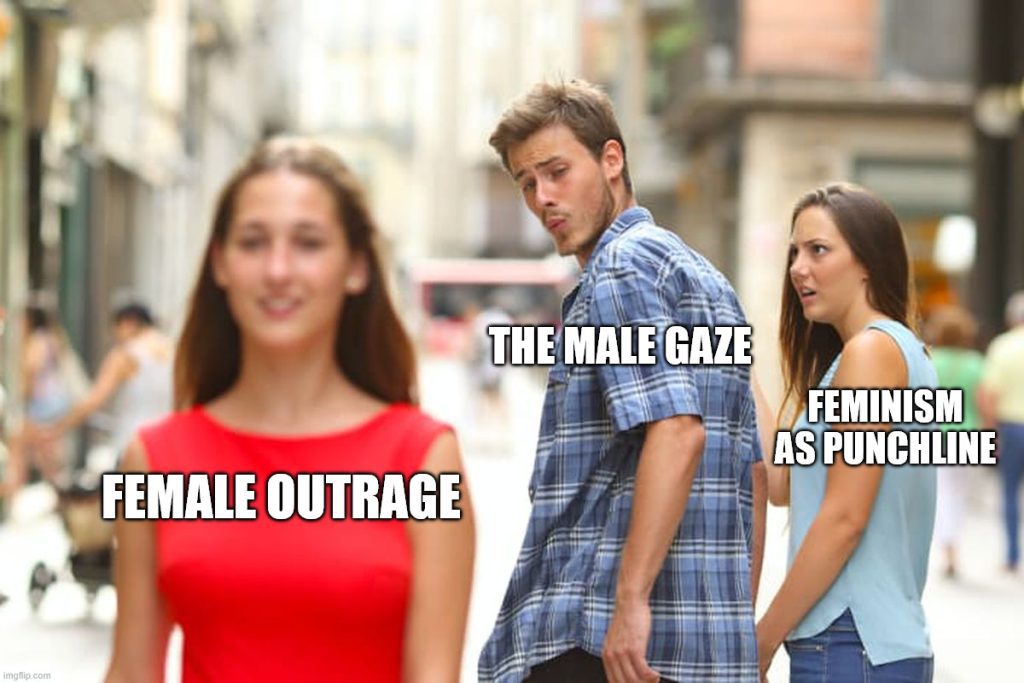
Let us not forget that before he was exposed as a toxic sex pest, Neil Gaiman—who I always thought was a fucking creep anyway—spent years publicly advocating for women’s rights, using every piece of progressive, feminist signalling available to insulate himself. The real danger of misogyny is that most men don’t even realise they are participating in it because it is the background radiation of our culture. Take the classic “distracted boyfriend” meme—the bloke craning his neck at the woman in the red dress while his partner looks on in disgust. We share it endlessly, but the punchline is simply the male gaze juxtaposed with female outrage, commodified into a digital chuckle. It’s the water we swim in.
The Race to the Bottom and the “Don’t Be a Dick” Doctrine: The Substack moderation controversy
If you want a masterclass in what a platform truly values, do not read its terms of service. Look at its leaderboards. The Substack moderation controversy is no accident.
You would think that a platform explicitly designed to “democratise media” and liberate writers from the capricious algorithms of legacy networks might occasionally elevate the next Virginia Woolf or William S. Burroughs. Instead, a quick glance at the top of the overarching ‘Fiction’ charts is a profoundly educational experience. Sitting proudly near the summit is an author whose primary marketing strategy appears to be posting booblicious photography to an eager demographic of heavily perspiring men. She is flanked by writers churning out the kind of aggressively formulaic, world-building fantasy that makes me want to stick pencils up my nose and headbutt the desk.
Then there are the micro-viral sensations that pop up in the algorithmic undergrowth. Take a recent arrival in my periphery: a bloke who managed to rack up dozens of subscribers overnight with just two posts. His grand literary debut? A 4chan-style confessional about losing his virginity in Japan to a woman with halitosis, followed swiftly by a vivid trauma-dump involving his cousin’s knickers and a clumsily deployed Jackson Pollock metaphor.
It is pure, unadulterated cultural sewage.
A younger, more naïve version of myself might have been furious that my carefully wrought, Beat-inspired stories were sitting unloved while this absolute twaddle gained traction. I might have felt a twinge of existential dread that the literary world had left me behind. But in truth it’s profoundly liberating. It is not exactly news to me that the world is going to shit, or that talent and truth are quaint, antiquated concepts that have aged about as well as a 1970s Carry On film.
Seeing the algorithm reward a moderately well-written panty-sniffing cringe confession, or a heavily monetised cleavage shot is merely a diagnostic tool. There is no tragedy here, no big new revelation. It simply confirms my darkest suspicions about the digital economy. I could write sordid, car-crash confessional drivel. I possess the vocabulary to make it sickeningly vivid. But why on earth would I want to attract an audience of bottom-feeders?
If you think this race to the lowest common denominator is just an algorithmic accident, you are wrong. It is the predictable, mathematical outcome of the platform’s foundational architecture and corporate philosophy. By combining a revenue-sharing model that directly profits from subscription growth with a libertarian approach to content moderation that allows hate speech to flourish, Substack has built a highly efficient engine for the monetisation of cultural grievance. Because the platform takes a flat ten percent commission on all paid subscriptions , it effectively positions the corporation as a direct beneficiary of digital hate. Frankly, the algorithm doesn’t care if a post is a pseudo-academic justification for male supremacy or a sticky homage to incestuous underwear, just so long as the reader’s credit card clears via Stripe.
The stark variance from platform to platform demonstrates unequivocally that the hosting and monetization of extremist content is not an inevitable consequence of the creator economy, but rather the direct result of deliberate corporate policy choices. Take Patreon, which enforces proactive community standards and explicitly prohibits content that spreads hate speech or uses dehumanising language. Or Beehiiv, which operates on a Software-as-a-Service (SaaS) model. Because Beehiiv charges a flat monthly fee rather than taking a cut of the subscription revenue, it does not directly profit from the viral success of a hate-mongering newsletter. Consequently, they are perfectly happy to aggressively enforce their Acceptable Use Policy and boot extremists off their servers. This is why there is a Substack moderation controversy.
Then there is Ghost, which represents a completely divergent architectural philosophy. Ghost offers a managed hosting service known as Ghost(Pro) , and for users relying on this infrastructure, Ghost enforces a strict, uncompromising Code of Conduct. They explicitly forbid “sexist, heterosexist, racist, or otherwise hateful remarks,” maintaining a blunt anti-harassment policy colloquially codified as the “Don’t be a Dick” rule. It proves powerfully that it is entirely possible to provide creators with ultimate technological freedom without a corporation actively subsidising, recommending, or facilitating hate speech on its proprietary servers.
Which brings me to my entirely unbothered exit.
If success in this particular ecosystem requires adopting faux-intellectual fascism, engaging in softcore engagement farming, or writing degrading trauma-dumps for algorithmic dopamine, it is a game I have precisely zero interest in playing. The house always wins, especially when the house takes ten percent of the rot.
I’ll be staying for now, because I know good people are still here, tucked away in the corners, holding onto truth and talent as if they still meant something. But don’t look for me to put my primary effort into this machine. I’ll be taking my words, my bespoke self-hosted VMs, and my Beat-inspired cynicism over to my own infrastructure. Substack can keep the irony bros, the engagement farmers, and the panty-sniffers.
I will still be here, appraising the vomit-strewn pavement of this fetid digital nightclub from time to time, ensuring I remember exactly why I usually give such venues a wide berth. I’ve got real work to do. I will be writing another two pieces about the Substack moderation controversy, one of the specifically to troll these testosterone-dripping pricks. Be sure to sign up for more, or you could even follow me on Substack if you like irony and hypocrisy.
